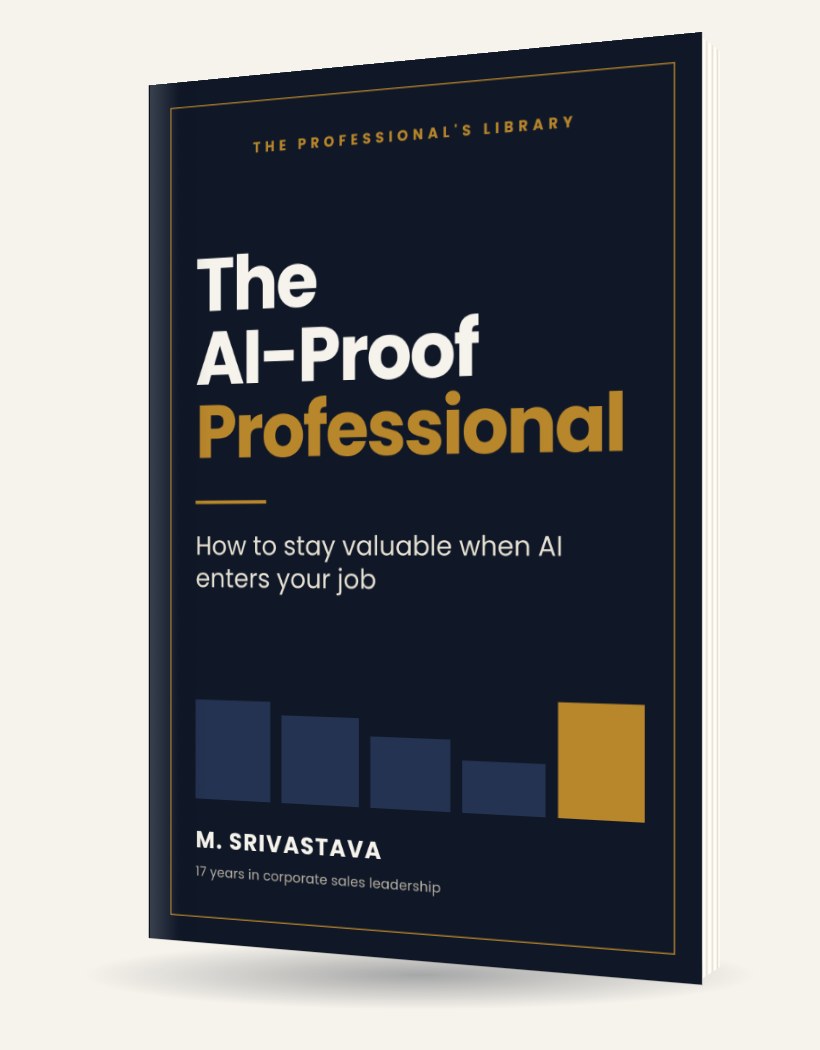
The Professional's Library
Nobody demoted him. His job title never changed. He did not get worse at his work.
One task in his week got cheaper, and he kept doing it by hand.
₹999 ₹499 · instant download · includes the Appraisal Simulator
I manage a sales floor of twenty people. What follows is not research. It is what I have watched happen since the end of 2024, to people whose appraisals I write.
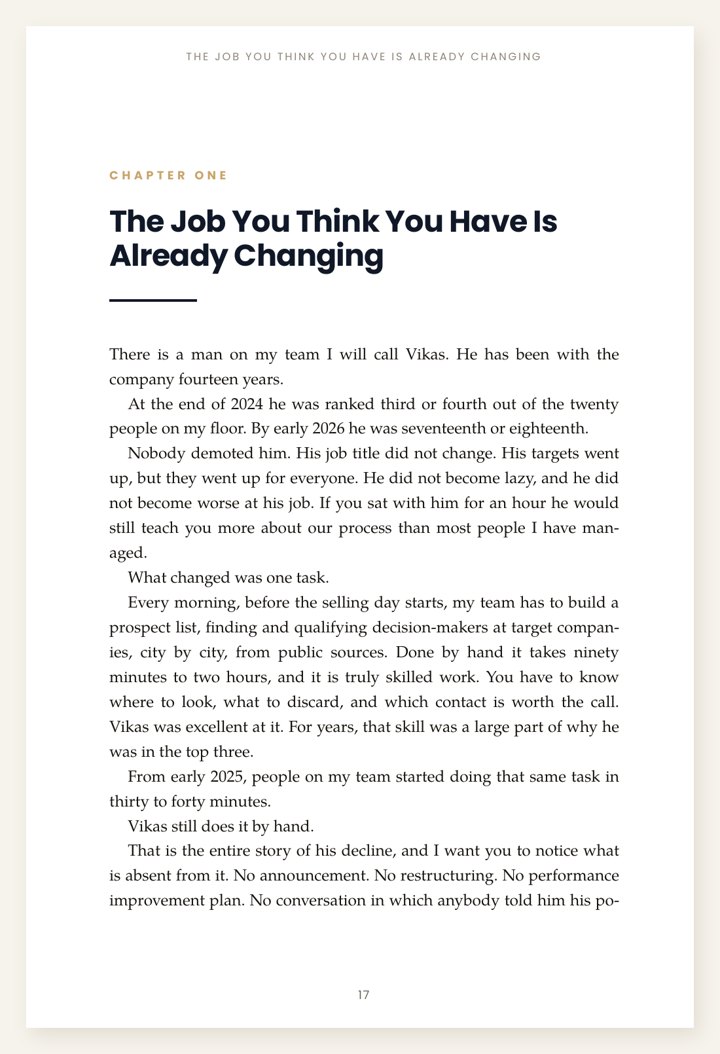
Fourteen years in the company
Rank 3 → Rank 18
Excellent at his job. Knows the process better than almost anyone. Every morning he builds his prospect list by hand — ninety minutes to two hours. From early 2025, the rest of the team started doing that same task in thirty minutes. He still does it by hand.
Eleven years in the company
Top five every year. Never promoted.
Consistently one of my best performers. Will not speak in a forum. Turned down a move to corporate sales because he is not comfortable talking to people face to face. When ranking comes around, everything I can say about him is about how well he does his current job — which is exactly the sentence that keeps a person where they are.
Seventeen years · no technical background
Now the man they name in meetings
Started in 2022 when he realised he could talk to a computer in plain English. For eighteen months the organisation quietly disapproved. Then he stopped using it to do his existing work faster and started building things that had not existed before. Our sales head now names him in front of the room.
The difference between them was not talent, tools or hours worked. It was one decision, taken deliberately — and most people never register that there was a decision to take.
Most professionals worry about the wrong scenario. The one in their head is dramatic: a day when the role is announced as redundant.
That does happen. It is rare, slow, and usually visible months in advance.
The far more common version is this. Nothing is announced. Your role continues. But over eighteen months the work you produce stops being impressive, because a colleague produces something comparable in a fraction of the time. Your headcount plan does not grow. And in your appraisal, meeting expectations appears where exceeding used to be, and the explanation you get is about scope and impact, and you find it frustrating and vague.
AI does not need to replace your job to change your career. It only needs to take enough of the valuable-looking work away that your organisation starts asking why your role exists in its current form.
Nobody in that story is being unfair to you. Your manager may not be able to articulate what changed either. But something did.
This is the conversation, close to word for word. He has fourteen years in the company and he was already slipping in the ranking.
"Ho jayega na. Aaj tak nahi hua hai kya? Abhi bhi ho jayega. AI se kuch nahi hota hai."
And later, when I showed him what was happening in the market:
"Main chalis saal ka ho gaya hoon, ab nayi cheez seekhne ka mann nahi hai mera. Jitna aata hai, usi ko kar raha hoon, bahut hai mere liye."
Nothing he said was foolish. He is right that the number had always happened. He is right that he knows this work. But every one of his answers was a statement about himself, and none of them was a statement about what the work is now worth.
I have thought about that conversation a great deal, and I think I handled it badly. The book says how, and what I do differently now.
₹999 ₹499 · 44,000 words · instant download
Eighteen chapters, five parts, and a set of tools you use at a desk rather than read on a couch. Every chapter ends with an exercise.
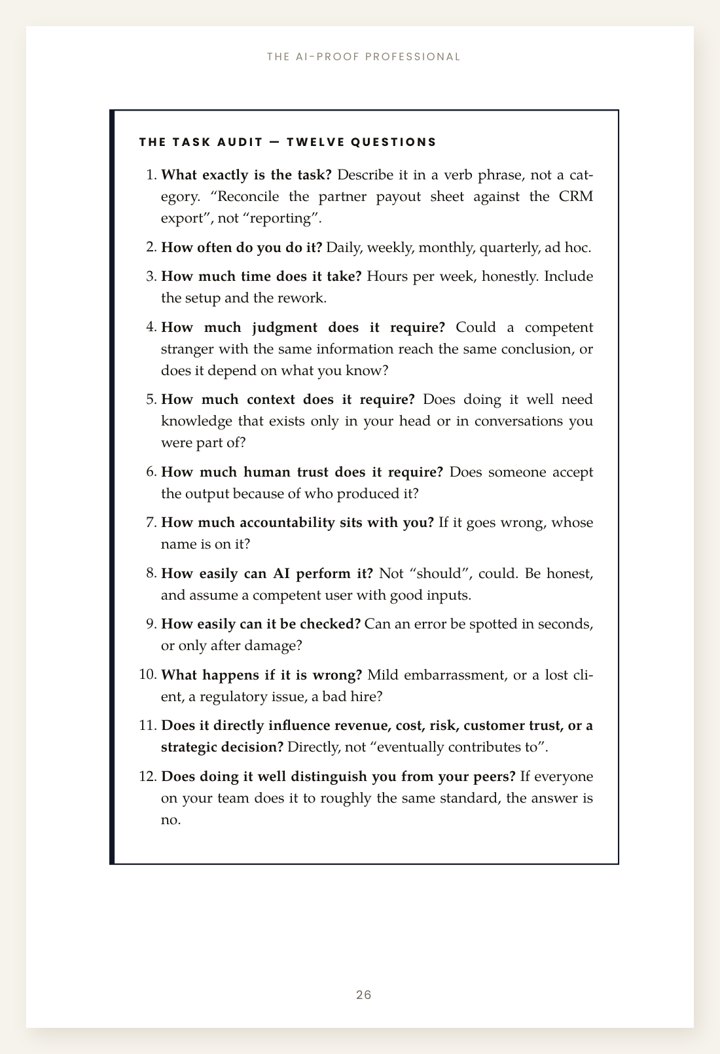
Break your job into its actual tasks and score each one. Twelve questions. Most people find 40–55% of their week sits in work whose price is falling.
Classify every task. Learn which parts of your contribution are getting cheaper and which are getting scarcer.
Pre-call research, proposals, follow-up, data analysis, meeting prep. Full prompts, verification steps, common mistakes.
Why fluent output is not evidence of correctness, and an eight-question check that stops one confident wrong number ending your reputation.
One action a day for a month. Audit, automate, redirect, measure, and have the conversation. With a scorecard.
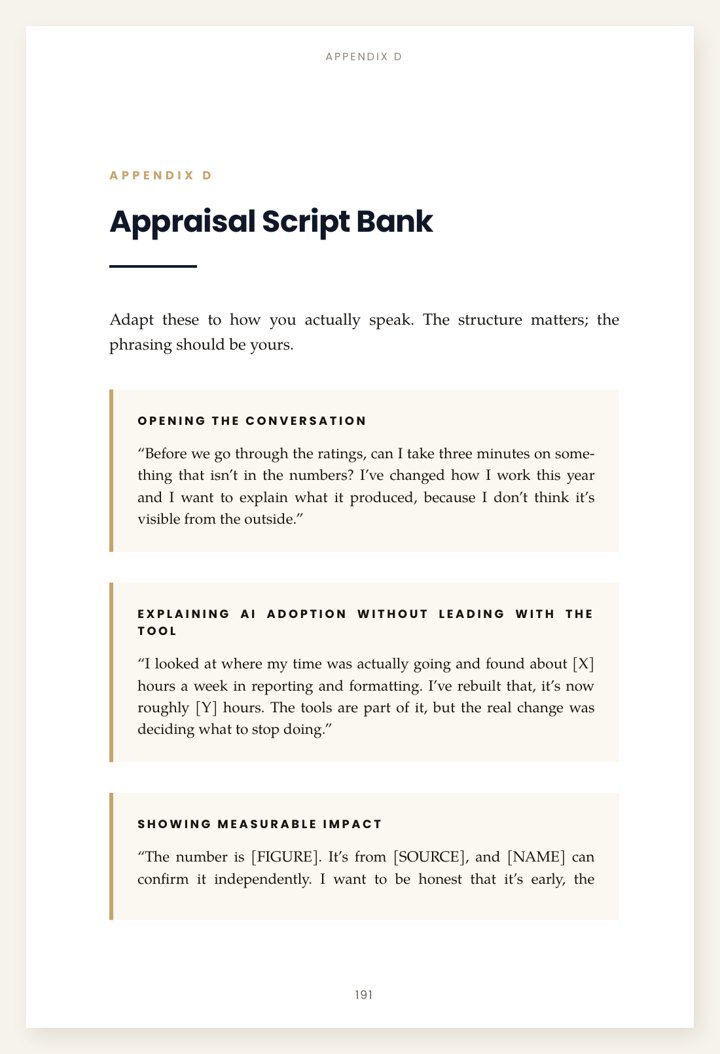
Word for word, for six real situations — including the sceptical manager and the manager who feels threatened by AI.
Real pages from the print edition. No stock images, no mock-ups of pages that do not exist.
Swipe to see all three pages.


Read the whole of Chapter 1 before you decide. It takes about eight minutes.
Read Chapter 1 free (PDF)Included free
Six situations. Your manager asks the questions. You type what you would actually say — and it scores your answer on the six things a manager listens for: specificity, ownership, outcome, evidence, redirection, and the ask.
Then it shows you how a strong answer sounds, and why.
It runs in your browser, works offline, and nothing you type is sent or stored anywhere. Close the tab and it is gone.
It is written from the side of the table that decides who stays valuable. Seventeen years of writing appraisals, defending headcount, and choosing between two people who look equally competent on paper. Most books on this subject are written by people who study technology. Almost none are written by someone who has had to justify a role in a calibration meeting.
Yes. Three men from my own floor, with names and identifying details changed, and their words reported as closely as I can remember them. Where an example is a composite instead, the book says so directly underneath it. No invented statistics, no fabricated testimonials, no anecdotes I did not witness.
No. The man in the third story has seventeen years in sales and no technical background at all. He got there in three years from a standing start, with a full-time job.
Yes. The whole of Chapter 1 is free, along with the author's note, how to use the book and the introduction. Read the free sample (PDF).
Two PDFs — one set for reading on a phone, one for a laptop or printing — plus the simulator as a file you open in any browser. All delivered by email immediately after payment, in one download.
About four hours of reading. The exercises take longer, and they are where the value is. The 30-day plan asks for fifteen to ninety minutes a day for a month.
No, and anyone who tells you otherwise is selling comfort. What it gives you is a way to see exactly where you are exposed, a method for the parts you can change, and the words to explain your value to the person who decides.
Email hello@srivastavadigitalservices.com from the address you paid with and the files will be sent to you again, as many times as you need. A failed download, a corrupted file, a lost email, a new phone — it does not matter why. You will not be asked to pay twice and you will not be left without the book you paid for.
The most dangerous professional position is not being exposed to AI.
It is being exposed and comfortable — competent, busy, well-regarded, and doing work whose price is falling, with nobody telling you and no reason to look.
The man who fell from third to eighteenth was in that position for a year. He was one of the most capable people I have managed.
₹999 ₹499 · one payment · instant download
Delivered to your inbox in a minute or two. If your download ever fails, write to me and I will send the files again — however many times you need.